Opening Hours: Mon-Fri: 09:00 AM - 05:00 PM, Sat: 10:00 AM - 02:00 PM
We offer you high quality cuttings of blue honeysuckle, Haskap Japanese (Lonicera caerulea var. emphyllocalyx), nicely tillered with a well developed root system.
All the cuttings in our plant-nursery are propagated vegetatively.
Our assortment includes the following varieties:
The blue honeysuckle / Haskap japanese
(Lonicera caerulea var. kamtshatica, L.c. var. emphyllocalyx)
Container P9/P11
– Colin – Haskap Japanese (license)
– Lori – Haskap Japanese (license)
– Tomi – Haskap Japanese (license)
– Maxin – Haskap Japanese (license)
– Villa – Haskap Japanese (license)
– Aurora – Canadian variety (license)
– Honeybee – Canadian variety (license)
– Wojtek – Polish variety
– Zojka – Polish variety
We are a registered plant-nursery (No. 14/28/19433) and all production takes place under the supervision of the Plant Health and Seed Inspection Service (PIORiN).
We issue a CAC certificate.
We provide our customers with expert advice in the establishment and management of plantations.
We look forward to working with you.
+ 48 695-602-564

A shrub with upright, very strongly growing shoots, annual growth up to 1m. The fruit is elliptical, with a medium size, 2-3 g, the sweetest of the varieties of the Japanese Haskap. It is suitable for longer storage. Recommended as a dessert fruit and also for the processing industry.

A slender shrub with numerous strong and thick shoots. The fruit is barrel-shaped and elliptical, of medium-size. Sweet-and-sour taste. A prolific variety ripening in mid-June, valuable for the processing industry.

A big, slender shrub with strong shoots growing up to 1m in height annually. The fruit is big and very big, hard, of a spherical-barrel shape. The taste of the fruit is sweet-and-sour, the fruit is covered with a strong waxy coating. The variety ripens in June and stores well in refrigeration conditions after picking. Dedicated for dessert commercial plantations.

A shrub with a slightly wider, more spreading habit and medium strength of growth. Barrel-shaped, sweet-and-sour fruit with an average weight of 2.5-3.5 g. The variety is very prolific. Destination as dessert fruit and processing fruit.

A stocky shrub with thick shoots and medium growing strength. The fruit is spherical, big, with an average weight of 3-4.5 g , tart taste. It ripens uniformly in mid-June. A very prolific variety suitable for harvesting by combine harvester. It is dedicated to the processing industry.

Physiological and morphological features that distinguish HASKAP
The HASKAP fruit
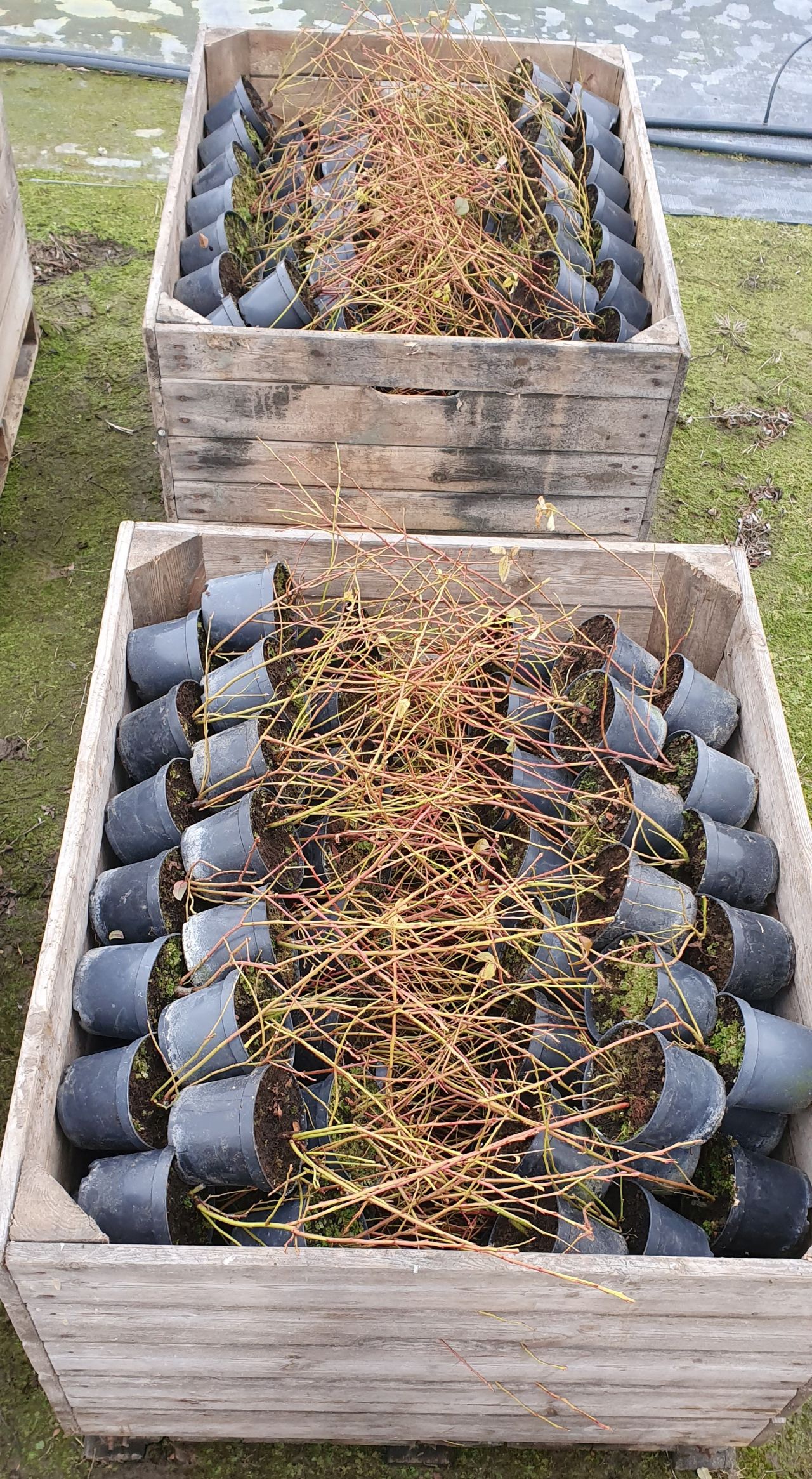
We pack cuttings in box-pallets of 120×100 cm or on trolleys (the so-called Danish trolleys), which ensures safe and economical transport.
The plants are provided with the necessary documents needed for plant transport, i.e. a plant passport.