Opening Hours: Mon-Fri: 09:00 AM - 05:00 PM, Sat: 10:00 AM - 02:00 PM
Dereń jadalny (łac. Cornus mas) Cornelian Cherry, Kornelkirsche
Our plant-nursery sells only varietal cuttings that have undergone grafting/T-budding, which ensures the repetition of the characteristics of the mother plant (variety). The cornelian cherries produced in this way enter the fruitage period more quickly (first fruit on 3-year-old plants) and are characterized by higher fertility, fruit weight than in the proper species.
Our assortment includes Polish and Ukrainian varieties, exclusively with red fruit. All the offered varieties have been observed by us on our plantation for several years. We have introduced into production only the ones that met the requirements for maturity date in the conditions of our country, fertility, alternate bearing and the possibility of mechanical harvesting.
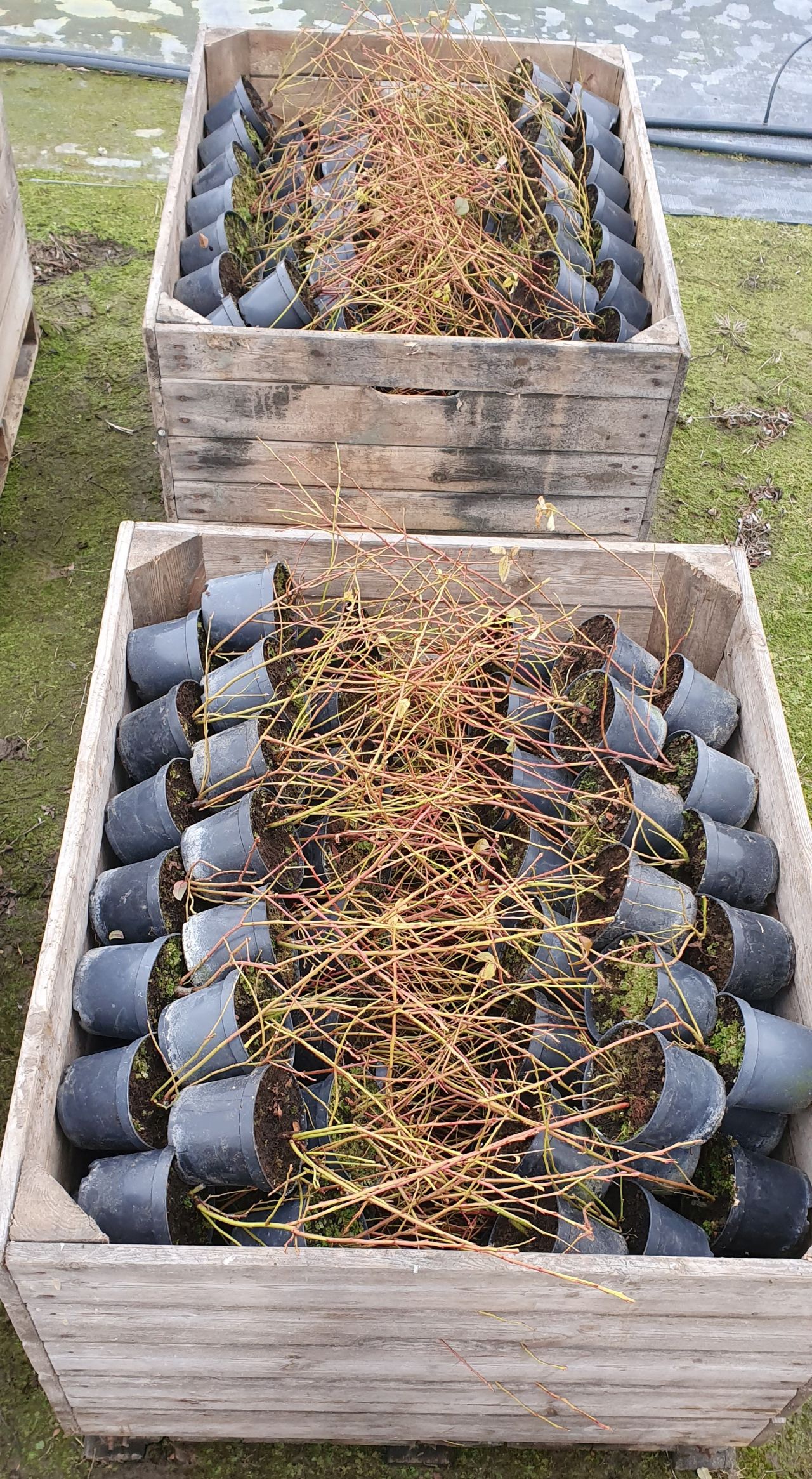
The cuttings we sell are one-year old plants propagated by T-budding, 70-100 cm high, in 2l pots. All cuttings have a fully rooted pot, which allows for planting on any date. The plants do not go through the stress associated with the changing of the growing conditions as is sometimes the case with plants bought bare-root.
For most of us the cornelian cherry is a plant that is not known too well, and few people know that it has been cultivated in Poland for a long time. In the past, a cornelian cherry shrub was present in almost every palace and manor garden. This species is one of the long-lived plants. Some specimens that are found are 100-200 years old.
Although it has gone a bit into oblivion over the past few years, it is now making a comeback and growing in popularity in an era where more and more attention is being paid to healthy eating.
In its natural habitat, the cornelian cherry is a big shrub and grows to a size of about 5m of height. It is one of the earliest flowering plants, with the first flowers appearing as early as mid-March. The shrubs are sprinkled with thousands of tiny yellow flowers which attract the first pollinating insects. The cornelian cherry is an open-pollinated plant except for only a few varieties that show partial self-pollination.
The fruit of the proper species is small (up to 2 cm), dark red, oval with a high percentage share of the stone in reference to flesh, it ripens in September numerously dropping off of the shrub.
The most important feature of this species is the fact that the fruit of the cornelian cherry is very rich in valuable nutrients: vitamin C, iron, calcium, magnesium, beta-carotene. It contains a lot of anthocyanins, polyphenols, organic acids, flavonoids which results in its strong antioxidant effect.
A Polish variety (licensed by Arboretum in Bolestraszyce) ripening in late August. The fruit ripens fairly evenly, it is sweet, with a high sugar content of 14%. The color of the fruit is dark red, the proportion of stone to flesh is 12% and the weight of the fruit is 3.3- 4.5 g.
A Ukrainian variety with very tasty, juicy fruit ripening in mid-August. Fruit of oval shape and weight of 5 g, the share of the stone: 9%. It is a variety which has abundant fruit every year.
A Ukrainian variety (a seedling of the yellow Jantarnyj [Yantarny] variety) recommended mainly for raw consumption due to its delicate and sweet taste (sugar content 12.7%). The fruit ripens in mid-August, it is bright red, spherical and its average weight is 5.8- 6 g.
A variety of Ukrainian origin characterized by big fruit of 6-9 g. The fruit is sweet-and-sour, dark red, firm and is pear-shaped. This is the most late variety in our offer – ripening in the second half of September.
A Ukrainian variety with dark red, bottle-shaped fruit reaching a weight of 6-7.5 g. The fruit ripens in the second half of August. The proportion of stone in the fruit is 10%. A distinctive feature of this variety is that the fruit does not drop after ripening, the ripe fruit stays on the plant for 3 to 4 weeks.
An early Ukrainian variety ripening in mid-August. The fruit is dark red, pear-shaped with an average weight of 5-6 g, very tasty when raw. This variety ripens evenly and bears fruit very abundantly every year.
A Ukrainian variety ripening in late August. The fruit is oval, dark red, sweet-and-sour, with an average weight of 5.5-6 g, it ripens evenly and stays on the shrub for a long time. The flesh comes away well from the stone. The variety has a high and stable productivity.
A variety of Ukrainian origin with dark red, bottle-shaped fruit ripening in early September.
The average weight of the fruit is 6-7 g and the stone accounts for about 10.5% of the weight.
A Ukrainian variety with the biggest fruit reaching on average about 7 g and sometimes as much as 10 g in favorable conditions. Red-black fruit, pear-shaped, sweet-and-sour, very aromatic with a small stone accounting for 7.5% of the fruit weight. The ripening date is at the end of August, the ripe fruit maintains well on the shrub and stores well after harvesting.
The most popular Polish variety (bred in the Arboretum in Bolestraszyce), ripening in mid-September. The fruit is dark red, pear-shaped, with an average weight of 3-5.5 g. Thanks to a high sugar content of 14%, the fruit is very sweet, often considered to be the tastiest.
A Ukrainian variety beginning to ripen in late August. The fruit is pear-shaped, dark red, with a high weight averaging 7.5g (up to 9g in favorable conditions). The stone accounts for 10% of the fruit’s weight.
Cornelian cherry cultivation
The species is seen as undemanding in terms of cultivation, but in order for the plants to grow well, the right conditions must be met.
The cornelian cherry requires alkaline soils with a pH of 7-8. At the site where plantings are planned, there must be no stagnant water, the cornelian cherry does not tolerate periodic flooding. When cultivating the cornelian cherry, we must also pay special attention to the salinity of the soil, when the Ec is too high, the plant growth is inhibited, the leaf blade dries up, after which the whole plants die. It grows best in permeable and fertile soils. It requires sunny or semi-shaded sites, this has a great impact on the taste and coloration of the fruit and its rate of ripening. The cornelian cherry is a frost-resistant plant.
Planting the cornelian cherry
Before planting, scarify the soil in rows to a depth of about 40-50 cm to loosen the soil structure and aerate it. This will create the right conditions for the growth of young roots.
On soils that are not fertile, it is worth introducing additional humus in the form of composted manure, deacidified peat, compost. This can be done in a strip by row or by individually adding organic matter under each plant.
Plants should be planted in such a way that the grafting site is not placed under the ground. In plantations it is worth installing an irrigation system. The cornelian cherry has a rather shallow root system, on hot days the top layer of soil dries out quickly and water shortages appear on the plants which is manifested by the drying of the edges of the leaf blade. In irrigated plantations we also observe differences in growth, especially of young plants (they have much longer annual growth) and this also affects the size and quality of the harvest.
Standard plantings in commercial plantations are made at a spacing of 4 m between rows and 2-2.5 m in the row. If the planter decides to prune the plants strongly, these dimensions can be reduced to 3 m between the rows and 1.5 m in the row. When choosing such parameters, it is necessary to keep in mind the method of harvesting one selects and the size of the cultivation equipment at one’s disposal.
The fact that the cornelian cherry is an open-pollinated plant requires planting at least two varieties in a plantation.
The cornelian cherry does not like replanting, this especially refers to older plants. Thus, it is worth buying potted plants with an expanded root system, this way we will avoid the problem of rooting of planted plants as often happens when buying plants with bare root.
Fertilization of the cornelian cherry
One of the most important factors affecting the success of the cultivation is the pH of the soil, which must be kept at a level not lower than 7pH.
When choosing a site for the cornelian cherry, you should perform a soil analysis to be able, even before planting, to supplement missing nutrients and perform liming (with chalk) if the pH is too acidic. .
In later years, it is also worth performing liming annually to ensure optimal growth conditions for plants. The cornelian cherry responds very well to organic fertilization, you can provide the plants with composted manure or compost every year. When using mineral fertilizers, it is necessary to remember that these should be chloride-free fertilizers because the cornelian cherry is sensitive to chlorides. It is best to use multicomponent fertilizers and also those that contain calcium.
Pruning the cornelian cherry
The cornelian cherry is one of the plants that start vegetation very early, sap begins to circulate in the plant already at the end of February. This feature has a very strong influence on the timing of pruning which should take place in the plant’s dormant period, that is, from the end of September to the end of February. By performing pruning at this time we will avoid the outflow of sap from the plant (the cornelian cherry strongly secretes sap) and thus weakening the plant.
Wild growing cornelian cherry takes the form of a big shrub, however, for commercial plantations it is recommended to keep the plants in a woody form. Therefore, in order to obtain a trunk form, in the first years it is necessary to cut all branches to a height of 70 – 100 cm, leaving one main trunk, and in subsequent years to remove all shoots appearing in this section.
From the experiments carried out on our plantation, we observe that the cornelian cherry responds very well to short-shoot pruning – it develops a very large number of flowers, thus increasing the harvest and weight of fruit.
The basic form of cultivating cornelian cherry trees in plantations in Poland is the cup form, characterized by the absence of a guide. A plant managed in this way has 4-5 strong branches spread evenly towards the outside of the trunk. In our plantation, we are conducting an experiment concerning pruning the cornelian cherry in an axial, spindle form. It is a form that is highly applicable to most species of fruit crops adapted to combine harvesting.
This form allows to increase the compacting of the planting to a spacing of up to 3 m between rows and 1.5 m in the row. This makes it possible to plant more plants on a given area and thus increase the crop obtained per hectare.
We pack cuttings in box-pallets of 120×100 cm or on trolleys (the so-called Danish trolleys), which ensures safe and economical transport.
The plants are provided with the necessary documents needed for plant transport, i.e. a plant passport.